
Search Halifax County Divorce Records
Halifax County divorce records are maintained by the Circuit Court Clerk's Office in Halifax, Virginia. If you need a certified copy of a divorce decree, want to check a case from years past, or are confirming divorce details for legal or personal use, the clerk's office handles all such requests. Halifax County has divorce case records going back to 1831. This page explains how to search, who can access records, what fees apply, and where else to look if you need more information.
Halifax County Overview
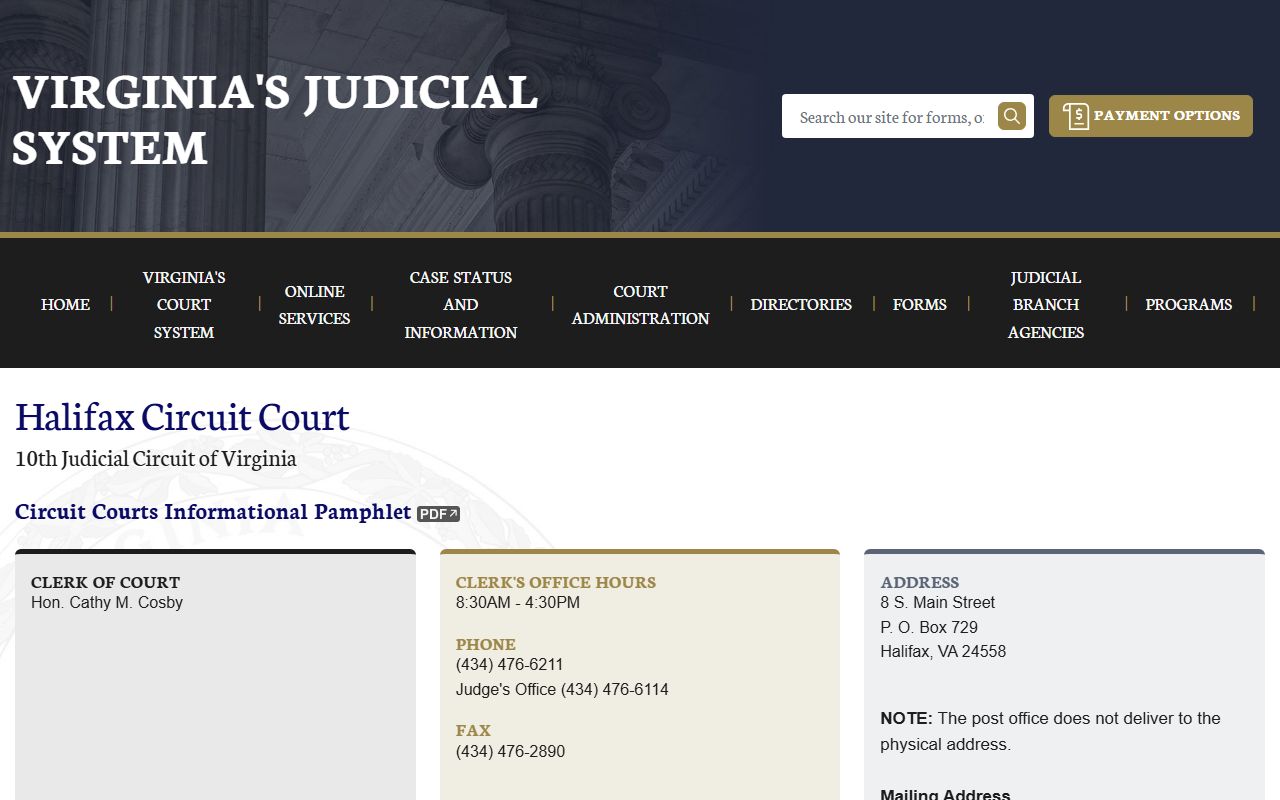
Circuit Court Clerk Office
Divorce cases in Halifax County are filed in the Circuit Court under Virginia Code § 20-96, which gives circuit courts exclusive jurisdiction over all divorce and annulment proceedings in Virginia. The clerk's office keeps all original filings, final decrees, and supporting case documents.
| Office | Halifax County Circuit Court Clerk |
|---|---|
| Address | P.O. Box 7, 8 S. Main Street, Halifax, VA 24558 |
| Phone | (434) 476-6211 |
| Hours | Monday-Friday, 8:30 AM - 4:30 PM |
| Website | vacourts.gov |
Hon. Cathy M. Cosby is the Clerk of Circuit Court for Halifax County. The clerk's office is a constitutional office, and its staff cannot give legal advice. But they can tell you what documents are available, how to request copies, and what fees to expect. Mail requests are accepted as well as in-person visits.
Note: For mail requests, include the full names of both parties, the approximate year of divorce, and a self-addressed stamped envelope along with your payment for copying fees.
Types of Divorce Records in Virginia
Virginia keeps three kinds of divorce records, each at a different level of government. Understanding the differences will help you ask for the right thing and avoid delays.
Divorce certificates come from the Virginia Department of Health. They are brief documents that confirm a divorce occurred. They list the names of both parties, the date of the decree, and the county where it was granted. They do not include detailed terms. These are the records VDH has maintained since 1918.
Final divorce decrees are the actual court orders that ended the marriage. They include terms for property division under § 20-107.3, spousal support, custody, and any name changes. These documents are held by the Circuit Court Clerk's office where the divorce was filed.
Divorce case files are everything that was submitted to the court during the case: the complaint, summons, financial statements, motions, and all other filings. These are also at the Circuit Court Clerk's office. They provide the most complete record of how and why a divorce was resolved the way it was.
How to Request Halifax Divorce Records
You can get Halifax County divorce records in person, by mail, or by searching basic case data online through the Virginia Judicial System website.
In-person is the quickest option. Go to the courthouse at 8 S. Main Street in Halifax during the hours listed above. Bring a valid ID. Tell the clerk the names of both parties and the year the divorce was granted. If you have the case number, bring it. Staff will locate the file and provide copies.
Mail requests work too, but take longer. Write to the clerk's office with the case details, your contact information, and a check or money order for copying fees. Include a stamped return envelope.
Online, the Virginia Judicial System's circuit court search lets you look up case status and basic information. You won't get actual documents this way, but you can confirm a case exists and find the case number before making a formal request.
Note: Online case search tools through the Virginia court system vary by county. Halifax County may have limited online records, so in-person or mail requests are often the most reliable route.
Record Access and Privacy Rules
Who can access Halifax County divorce records depends on how old the records are. Virginia Code § 32.1-271 restricts access to VDH divorce records for 25 years after the date of divorce. During that period, only the parties named in the record, immediate family members (parents, spouse, children, siblings, grandparents), or their attorneys may request copies.
After 25 years, divorce records become public. Anyone can request them without needing to explain why or prove a family connection. VDH transfers older records to the Library of Virginia, where they are accessible as archival public records.
Even after records go public, a court can order them sealed. Under § 20-124, a party to the divorce may ask the judge to seal the case file. If granted, those records stay confidential regardless of age. Courts use this option to protect children, sensitive financial data, or domestic violence information.
The Virginia Freedom of Information Act (§ 2.2-3700) establishes a general right of public access to government records, but vital records privacy statutes take precedence for the 25-year restriction period.
Fees for Divorce Records
Under § 17.1-275, the first certified copy of a final divorce decree is free to the parties named in the case. This is a statewide rule that applies in Halifax County. You do not pay for that first copy.
Additional copies cost $0.50 per page. If you need a certified copy of any other document in the case file, there is a $2.00 certification fee per document plus copying costs. Special certifications for international use or apostille can have additional fees.
Divorce certificates from VDH cost $12 each. You can start the application online at vdh.virginia.gov/vital-records, but the form must be printed, signed, and submitted with a valid ID by mail or in person. The VDH walk-in location in Richmond is open weekdays.
Filing a new divorce case costs $60 in Virginia. That fee is paid to the clerk at the time of filing and is the same across all Virginia counties. It includes the first certified copy of the final decree once the case is complete.
Legal Resources for Halifax County Residents
Handling a divorce on your own is possible in Virginia, but having the right resources matters. Several free or low-cost options are available for Halifax County residents.
The Virginia Judicial System runs a divorce self-help page that explains what circuit courts can handle in a divorce case: ending the marriage, dividing property, setting support, and addressing custody. It also links to court forms and other resources for people representing themselves.
The Virginia State Bar's guide to divorce in Virginia explains the legal process in straightforward terms. It covers the difference between a full divorce and a divorce from bed and board, and what "equitable distribution" means for property. This guide is free and does not require you to be a lawyer to understand it.
Low-income Halifax County residents may qualify for help through Virginia Legal Aid. Legal Aid attorneys can assist with divorce filings, custody questions, and protective orders at no charge for those who meet income guidelines. Contact the nearest office to find out if you qualify.
Virginia requires at least six months of residency in the state before you can file for divorce. Grounds for divorce are set out in § 20-91. No-fault divorce requires one full year of separation, or just six months if both parties have signed a separation agreement and have no minor children together.
Nearby Counties
These Virginia counties are near Halifax County. Each has its own Circuit Court and maintains local divorce records.