
Virginia Divorce Records
Virginia divorce records are kept at the Circuit Court Clerk's office in the county or city where the divorce was filed. The state has 95 counties and 38 independent cities, each with its own Circuit Court that holds divorce case files and decrees. You can search for Virginia divorce records online, visit a courthouse in person, or request copies by mail. For certified divorce certificates, the Virginia Department of Health Office of Vital Records holds statewide records going back to 1918 and can issue certified copies for eligible requesters.
Virginia Divorce Records Overview
Where Virginia Divorce Records Are Kept
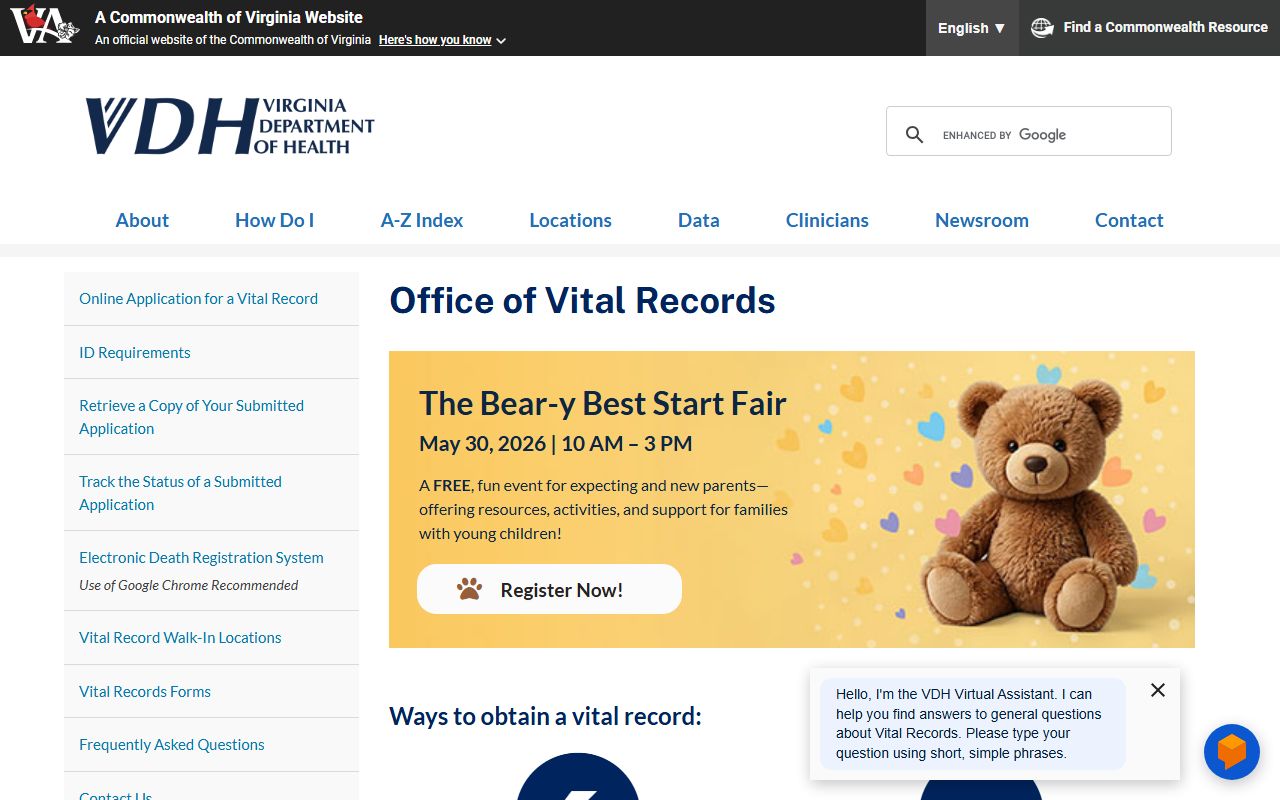
Virginia maintains divorce records at two levels of government. The Virginia Department of Health Office of Vital Records holds divorce certificates from 1918 to the present. These are basic documents that confirm a divorce took place, listing the names of both parties, the date, and the county where it was finalized. The VDH office is located at 8701 Park Central Drive, Suite 100, Richmond, VA 23227. You can reach them at 804-662-6200, Monday through Friday, 8:00 AM to 4:30 PM.
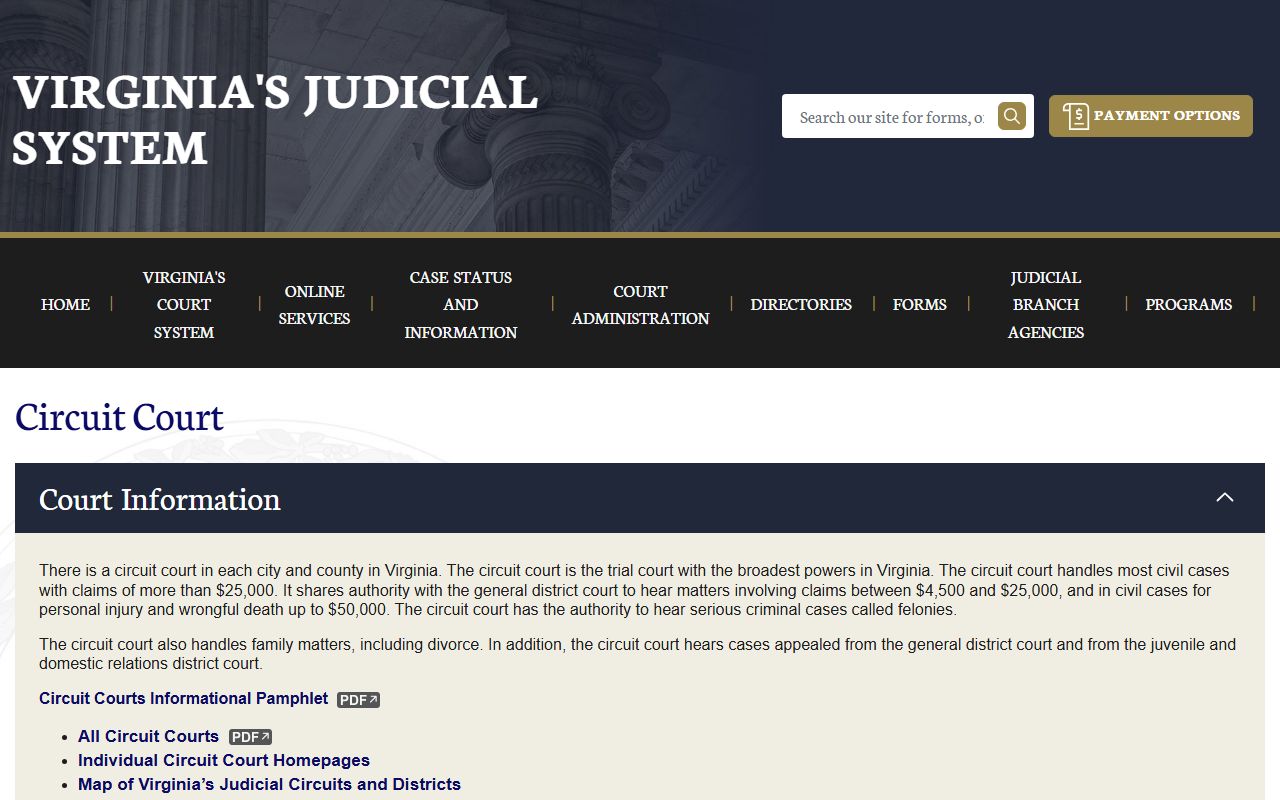
The Clerk of the Circuit Court in the county or city where the divorce was granted holds the full set of records. This includes the final divorce decree, the original petition, property agreements, custody orders, and all other papers filed in the case. Under Virginia Code § 20-96, the Circuit Court has exclusive jurisdiction over divorce cases. Virginia has 120 circuit courts spread across 31 judicial circuits. Each court keeps its own records and can issue certified copies.
The VDH and the Circuit Court serve different needs. Go to VDH if you need a basic divorce certificate. Go to the Circuit Court Clerk if you need the actual decree, case file, or details about the divorce settlement.
The Virginia Judicial System website lists all circuit courts. You can search case information online for most courts at vacourts.gov. The Alexandria and Fairfax circuit courts are not listed in the statewide online system, but both operate their own separate portals.
How to Search Virginia Divorce Records
Online is the fastest way to start your search. The Virginia Judicial System offers Circuit Court case information for most counties. You can search by party name, case number, or hearing date. The results show basic case info, docket entries, and hearing dates. This is free to use. Full document images are not available online, so if you need the actual paperwork you will still need to contact the courthouse.
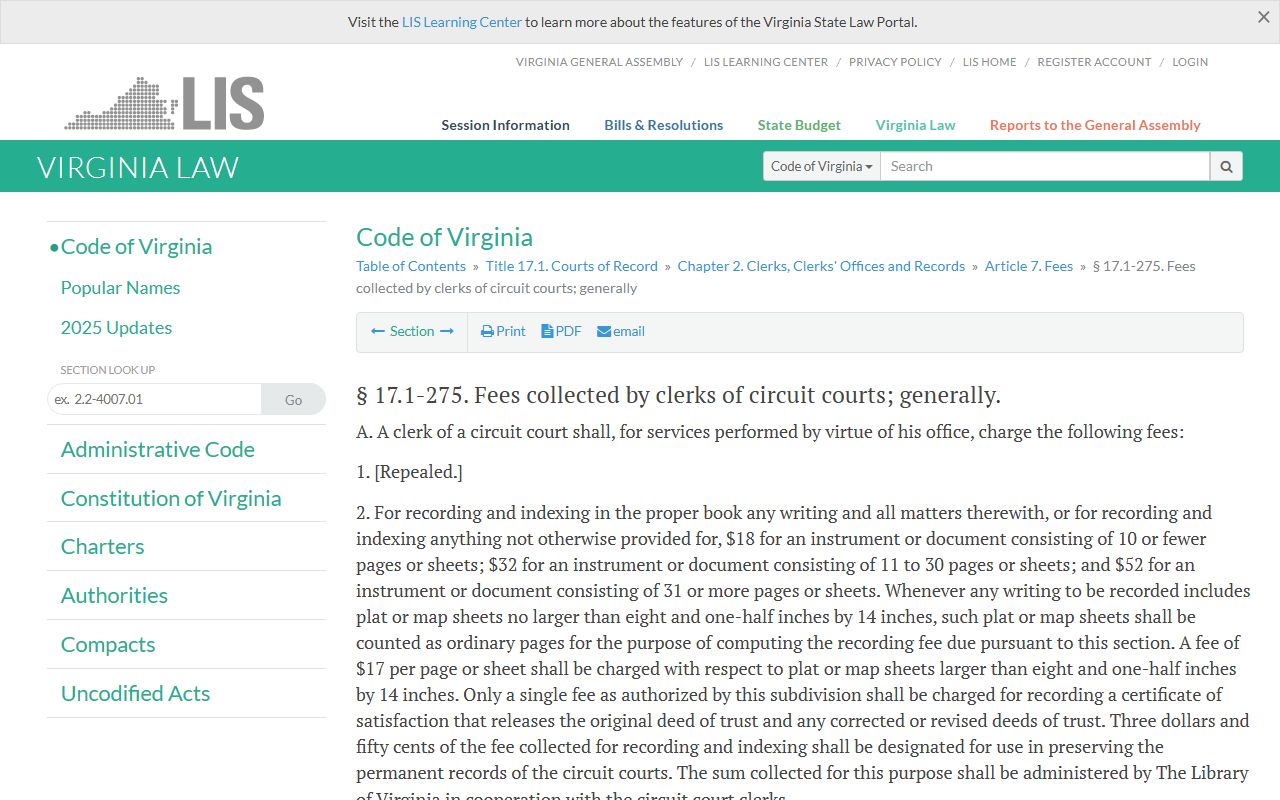
To search in person, go to the Circuit Court Clerk's office in the county or independent city where the divorce was filed. Bring a valid photo ID. The clerk can pull up records by name or case number. Plain copies cost $0.50 per page. Certified copies cost $2.00 per document plus the per-page fee. Under Virginia Code § 17.1-275, the first certified copy of a final divorce decree is provided free of charge to the parties in the case. This is a significant benefit if you are getting your own divorce decree.
Mail requests are accepted by most Circuit Court clerks. Send a written request with the names of both parties, the approximate year of the divorce, and the case number if you have it. Include a self-addressed stamped envelope and a check or money order for any copy fees. Processing time varies by court but typically runs one to two weeks.
For a divorce certificate from VDH, complete the application form at vdh.virginia.gov/vital-records. Print it, sign it, and mail it with a legible copy of your ID and the $12 fee. You cannot submit the VDH form online, only print and mail or bring it in person. Processing takes two to four weeks by mail.
Types of Virginia Divorce Records
Virginia maintains three distinct types of divorce records. A divorce certificate is a short document issued by VDH that proves the divorce happened. It lists the names of the parties, the date, and where the divorce was finalized. This is what you need to prove your marital status for things like remarriage or name-change paperwork. Certificates are available from the VDH Office of Vital Records for divorces from 1918 to present.
The final divorce decree is the court order that ended the marriage. It is the most detailed and important document. It sets out all the terms the court ordered, including property division, spousal support, child custody arrangements, visitation, and child support amounts. This document is kept by the Circuit Court Clerk in the county where the divorce was granted. Per Virginia Code § 32.1-268, clerks are required to report each final divorce decree to the State Registrar by the 10th day of each month.
The divorce case file holds every paper filed from start to finish. This includes the original petition, service of process documents, financial affidavits, temporary orders, any separation or property settlement agreements, and the final decree. The Circuit Court Clerk holds these files. Most are open to the public, though financial source documents and records involving minors may have restricted access.
Who Can Access Virginia Divorce Records
Access rules in Virginia depend on how old the record is. Under Virginia Code § 32.1-271, divorce records held by the VDH Office of Vital Records are restricted for 25 years from the date of the divorce. During that period, only the parties named in the record and their immediate family members can get copies. Immediate family includes parents, spouse, children, siblings, and grandparents with valid identification. Aunts, uncles, cousins, in-laws, and others cannot obtain vital records during the restricted period.
After 25 years have passed, divorce records become public information. Anyone can request them from VDH. Original records that reach the 25-year mark are transferred to the Library of Virginia for public access. Social security numbers are always redacted from public copies of records.
Circuit Court records work differently. Final divorce decrees and case files at the Circuit Court are generally public records under the Virginia Freedom of Information Act, § 2.2-3700. You do not have to be a party in the case to ask for copies at the courthouse. However, under Virginia Code § 20-124, a party may ask the court to seal the record or any part of it. If a record is sealed, it can only be opened to the parties, their attorneys, and others the judge approves.
Note: Even after 25 years, records that were sealed by a court order stay confidential. A sealed record does not become public just because time has passed.
Virginia Divorce Record Fees
Fees for Virginia divorce records vary by source. VDH charges $12 per certified divorce certificate copy. Pay by check, money order, payment card, mobile pay, or cash. Personal checks are accepted at the VDH walk-in location but confirm by phone first. Mail requests require a check or money order.
At the Circuit Court Clerk's office, the first certified copy of a final divorce decree is free to the parties in the case under Virginia Code § 17.1-275. Additional certified copies cost $2.00 per document plus $0.50 per page. Plain copies (not certified) cost $0.50 per page. Some courts charge a $5.00 search fee as well. Individual counties may have slight variations in their fee schedules, so call the specific clerk's office to confirm current costs before you request records.
Filing for divorce in Virginia costs $60 at the Circuit Court, with $10 of that going to the Courts Technology Fund. This covers the filing fee and includes a certified copy of the final decree.
Virginia Divorce Laws and Grounds
Virginia law recognizes two types of divorce. A divorce from the bond of matrimony is a full, absolute divorce that ends the marriage completely. A divorce from bed and board is a partial or qualified separation where the parties are legally separated but cannot remarry. Either party in a bed-and-board divorce can ask the court to convert it to a full divorce after at least one year from the date of the original separation.
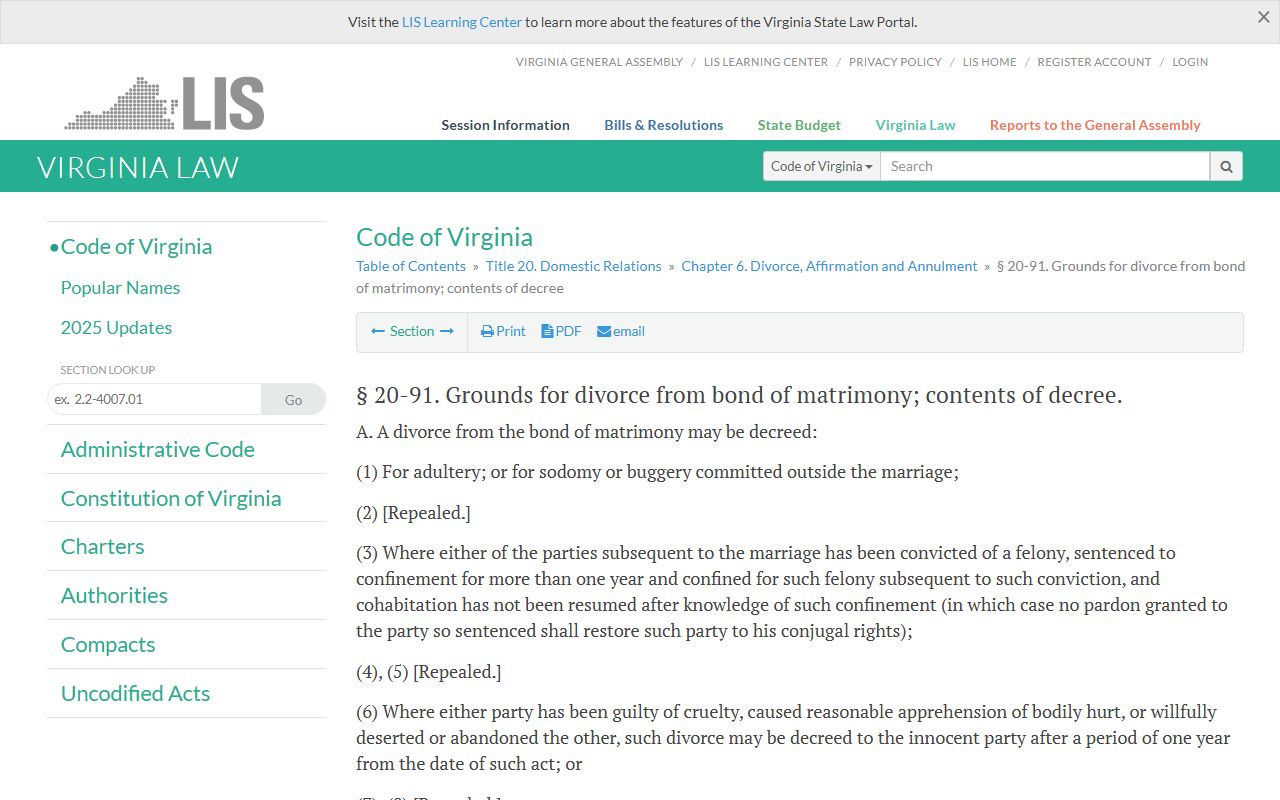
Under Virginia Code § 20-91, divorce may be granted on several grounds. No-fault divorce requires the parties to have lived separate and apart without cohabitation for one year. If the parties have no minor children and have a written separation agreement, the waiting period drops to six months. Fault-based grounds include adultery, conviction of a felony with confinement for more than one year, cruelty causing reasonable fear of harm, and willful desertion or abandonment lasting at least one year.
You must meet the residency requirement before filing. At least one spouse must have been a Virginia resident for six months before filing. The divorce is filed in the Circuit Court in the county or independent city where either spouse resides.
Property division in Virginia follows an equitable distribution model under Virginia Code § 20-107.3. The court divides marital property in a way it finds just and fair, but not necessarily equal. The court considers factors like the length of the marriage, each spouse's financial contributions, and the relative monetary and non-monetary contributions each made to the well-being of the family. Separate property, meaning what each spouse owned before the marriage or received as a gift or inheritance, is generally not subject to division. The Virginia State Bar provides a useful summary of divorce law in Virginia for those who want more background.
Legal Help with Virginia Divorce Records
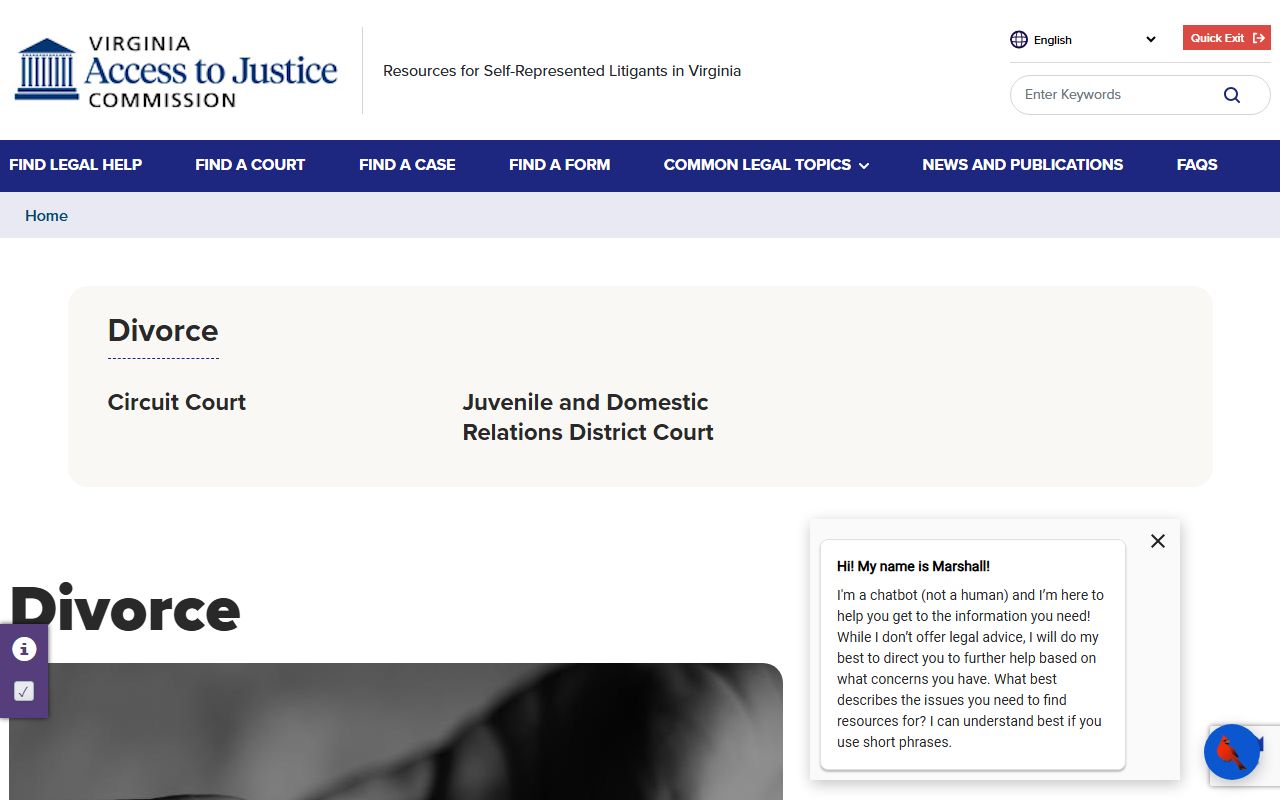
The Virginia Judicial System provides self-help resources at selfhelp.vacourts.gov. This site walks you through the divorce process, explains the types of cases the court handles, and links to practical guides on financial matters and custody. Virginia Legal Aid offers free civil legal help to people who qualify based on income. Visit valegalaid.org to find your local legal aid office and learn what they cover.
The Virginia State Bar runs a lawyer referral service. You can reach them at vsb.org and they can connect you with a family law attorney in your area. The bar also publishes a consumer guide to divorce in Virginia at vsb.org. Many courthouses have a self-help desk or law library where staff can point you to forms, though they cannot give legal advice.
Note: Court staff cannot provide legal advice. If you have questions about your specific case, contact an attorney or a legal aid organization in your area.
Browse Virginia Divorce Records by County
Each Virginia county has its own Circuit Court Clerk that handles divorce filings and maintains divorce records. Select a county below to find local courthouse contact info, online search options, and resources for finding divorce records in that area.
Virginia Divorce Records by City
Virginia has 38 independent cities, each with its own Circuit Court. Select a city below to find out where divorce records are held and how to request them.